
Lumens describe emitted light, lux describes light reaching a surface, watts describe power and kelvin describes colour appearance.
Start with the problem, not the product photograph
Electrical compatibility and visual quality are different questions. For Lumens, lux, watts and kelvin without confusion, begin at the rating label and finish with a documented trial.
Photograph the proposed position straight on and from the side. Record the full dimensions, lampholder, bulb, connection method and the main task. A close product image rarely shows room scale, door movement or the angle from which a bare bulb becomes visible.
Three distinct decisions
1. Decide the job before the style
Choose the measure that answers the real question instead of using wattage as a substitute for brightness.
Keep this evidence: write the main task and the one constraint that could rule the fitting out.
2. Measure the real fitting envelope
Record bulb lumens and watts, distance to the task surface, measured comparison lux and kelvin.
Keep this evidence: record every dimension from one named reference point and photograph the tape measure in place.
3. Test the result from normal positions
Compare on the page, benchtop or floor that matters; a bright shade does not prove useful illumination elsewhere.
Keep this evidence: repeat the check by day and after dark, using the bulb and furniture layout you expect to keep.
Worked calculation
Approximate illuminance concept
E = Φ ÷ A
Variables: E is average illuminance in lux, Φ is lumens reaching the surface and A is area in square metres. Real fittings are not perfectly uniform.
Example: If an estimated 300 lumens reach a 1.5 m² surface, E = 300 ÷ 1.5 = 200 lux. Coloured glass and distance can reduce and redistribute that light.
The calculation gives a planning check, not an installation approval. Confirm the maker’s dimensions, use a full-size mock-up and let the appropriately qualified person decide structural and fixed-wiring details.
A real TiffanyLight.co.nz product as the worked case
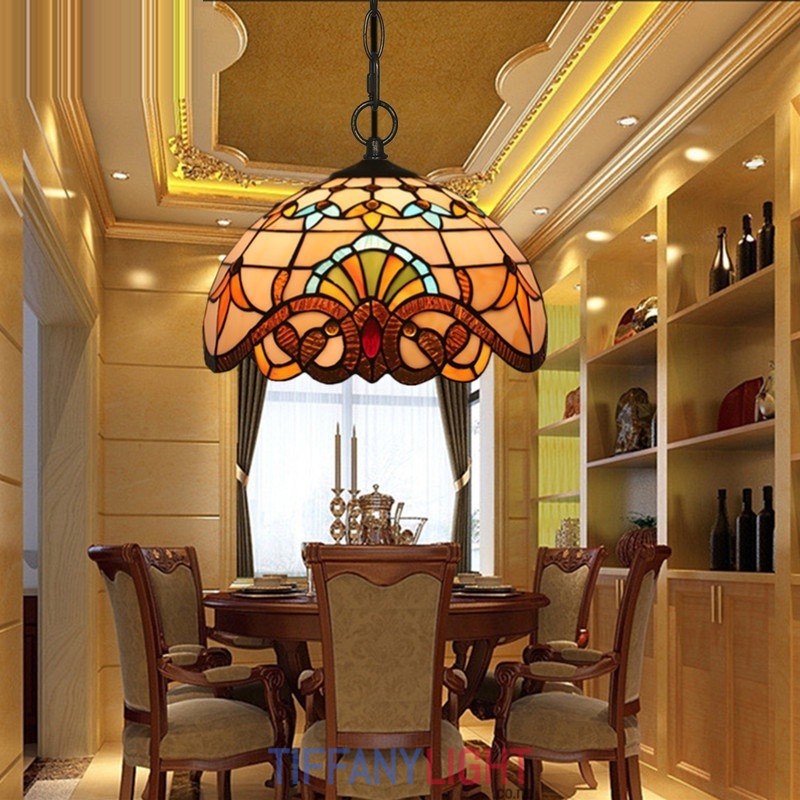
30 cm Baroque-style stained-glass pendant
A compact 30 cm pendant used to test table margins, hanging height and the difference between shade diameter and total suspended size.
This model demonstrates the method; it is not an automatic recommendation. Draw its complete dimensions, verify the current electrical specification and test the proposed light in the real room. Product details can change, so check the live page before buying.
Confirm on the product page: total dimensions, weight, voltage and connection, lampholder, maximum wattage, included parts and installation conditions.
Practical New Zealand home scenario
Photograph the fitting label and compare two compatible LEDs where only one property changes. Confirm the globe fits, remains clear of glass and is hidden from normal view. Record the exact bulb model that gives the most stable, useful result.
Common mistakes
- Guessing the bulb cap or voltage from a photograph.
- Confusing watts, lumens, lux and kelvin.
- Assuming every dimmable LED works with every dimmer.
Final checklist
- The fitting label has been read.
- Voltage and maximum wattage are respected.
- The globe fits without contact.
- Lumens, kelvin and CRI are recorded.
- Dimming is stable across the useful range.
Record sheet: model, complete dimensions, total weight, voltage and connection, lampholder, chosen LED, position, mock-up photograph and check date. The current product information and maker’s instructions take priority over general guidance.
Explore relevant lamps
Tiffany table lamps · Tiffany floor lamps · Tiffany pendant lights · Tiffany wall lights · Tiffany flush lights · Tiffany chandeliers