
A dark room does not automatically need the palest shade; useful light depends on glass transmission, shade opening and other sources too.
Start with the problem, not the product photograph
Stained glass has no single fixed colour. For Best Tiffany lamp colours for a dark room, test daylight, LED spectrum, wall and textile inside the real room.
Photograph the proposed position straight on and from the side. Record the full dimensions, lampholder, bulb, connection method and the main task. A close product image rarely shows room scale, door movement or the angle from which a bare bulb becomes visible.
Three distinct decisions
1. Decide the job before the style
Separate the need for brighter ambient light from the desire for a luminous coloured object.
Keep this evidence: write the main task and the one constraint that could rule the fitting out.
2. Measure the real fitting envelope
Record room surfaces, window contribution, lamp lumens and where light actually reaches the floor, wall and task plane.
Keep this evidence: record every dimension from one named reference point and photograph the tape measure in place.
3. Test the result from normal positions
Use a portable light meter only as a comparison tool and inspect faces, books and walking routes—not just the glowing shade.
Keep this evidence: repeat the check by day and after dark, using the bulb and furniture layout you expect to keep.
Worked calculation
Simple reflected-light comparison
R = Esurface ÷ Ereference × 100%
Variables: R compares light at a target surface with an unobstructed reference reading; it is not a material certification.
Example: If the page receives 180 lux while the reference position receives 300 lux, R = 180 ÷ 300 × 100 = 60%.
The calculation gives a planning check, not an installation approval. Confirm the maker’s dimensions, use a full-size mock-up and let the appropriately qualified person decide structural and fixed-wiring details.
A real TiffanyLight.co.nz product as the worked case
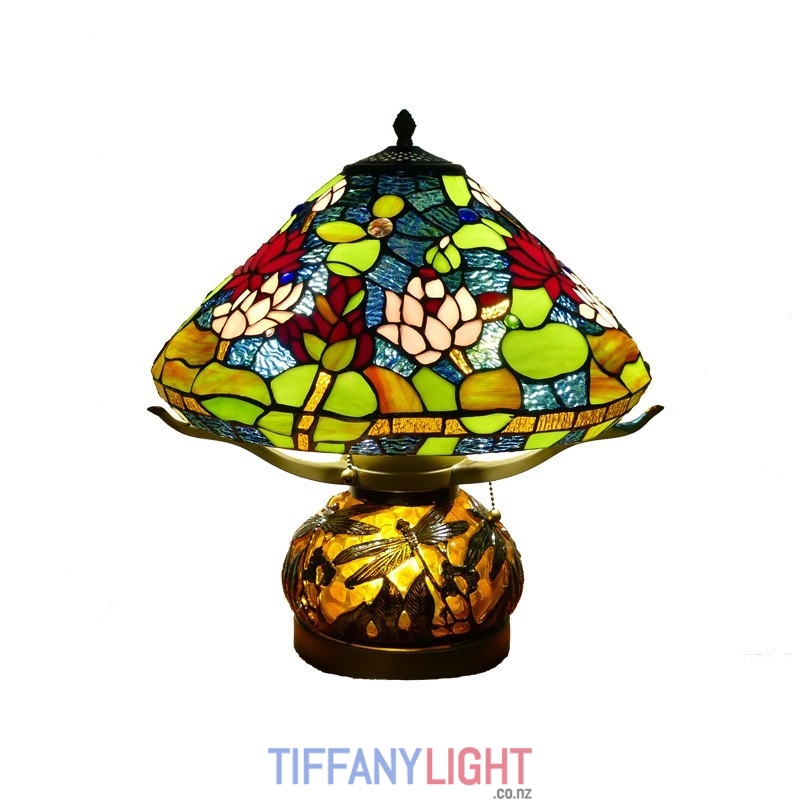
40 cm water-lily Tiffany-style table lamp
A large floral table lamp used for side-table footprint, warm colour and layered living-room lighting examples.
This model demonstrates the method; it is not an automatic recommendation. Draw its complete dimensions, verify the current electrical specification and test the proposed light in the real room. Product details can change, so check the live page before buying.
Confirm on the product page: total dimensions, weight, voltage and connection, lampholder, maximum wattage, included parts and installation conditions.
Practical New Zealand home scenario
Try two compatible LEDs with the same shape and similar lumens but different kelvin. Photograph 40 cm water-lily Tiffany-style table lamp, skin, timber and wall from one fixed viewpoint. Choose the combination that makes the whole room convincing, not simply the one that makes the glass appear brightest.
Common mistakes
- Changing kelvin, lumens and bulb shape at the same time.
- Judging the glass only when illuminated.
- Ignoring New Zealand daylight and window reflections.
Final checklist
- Glass is assessed by day and night.
- Kelvin and lumens are treated separately.
- The background is tested in the room.
- Skin, timber and textiles look natural.
- Comparisons use one camera angle.
Record sheet: model, complete dimensions, total weight, voltage and connection, lampholder, chosen LED, position, mock-up photograph and check date. The current product information and maker’s instructions take priority over general guidance.
Explore relevant lamps
Tiffany table lamps · Tiffany floor lamps · Tiffany pendant lights · Tiffany wall lights · Tiffany flush lights · Tiffany chandeliers