
A living room needs ambient, task and accent light; one stained-glass fitting rarely performs all three roles evenly.
Start with the problem, not the product photograph
Rooms are used from several positions and at different times. For Layering Tiffany lamps in a living room, judge daylight, evening scenes, movement and tasks separately.
Photograph the proposed position straight on and from the side. Record the full dimensions, lampholder, bulb, connection method and the main task. A close product image rarely shows room scale, door movement or the angle from which a bare bulb becomes visible.
Three distinct decisions
1. Decide the job before the style
Assign a separate lighting job to conversation, reading, television, cleaning and safe movement through the room.
Keep this evidence: write the main task and the one constraint that could rule the fitting out.
2. Measure the real fitting envelope
Sketch lamp positions and note dark corners, television reflections, socket locations and seated eye heights.
Keep this evidence: record every dimension from one named reference point and photograph the tape measure in place.
3. Test the result from normal positions
Run a normal evening scene for each activity and change one light at a time so the contribution of the Tiffany lamp is clear.
Keep this evidence: repeat the check by day and after dark, using the bulb and furniture layout you expect to keep.
Worked calculation
Task share of available light
S = Lt ÷ Ltotal × 100%
Variables: Lt is lumens assigned to the task source and Ltotal is rated lumens in the scene.
Example: A 600-lumen reading lamp in a 2100-lumen evening scene contributes S = 600 ÷ 2100 × 100 ≈ 29% of rated lumens. Position still determines what reaches the page.
The calculation gives a planning check, not an installation approval. Confirm the maker’s dimensions, use a full-size mock-up and let the appropriately qualified person decide structural and fixed-wiring details.
A real TiffanyLight.co.nz product as the worked case
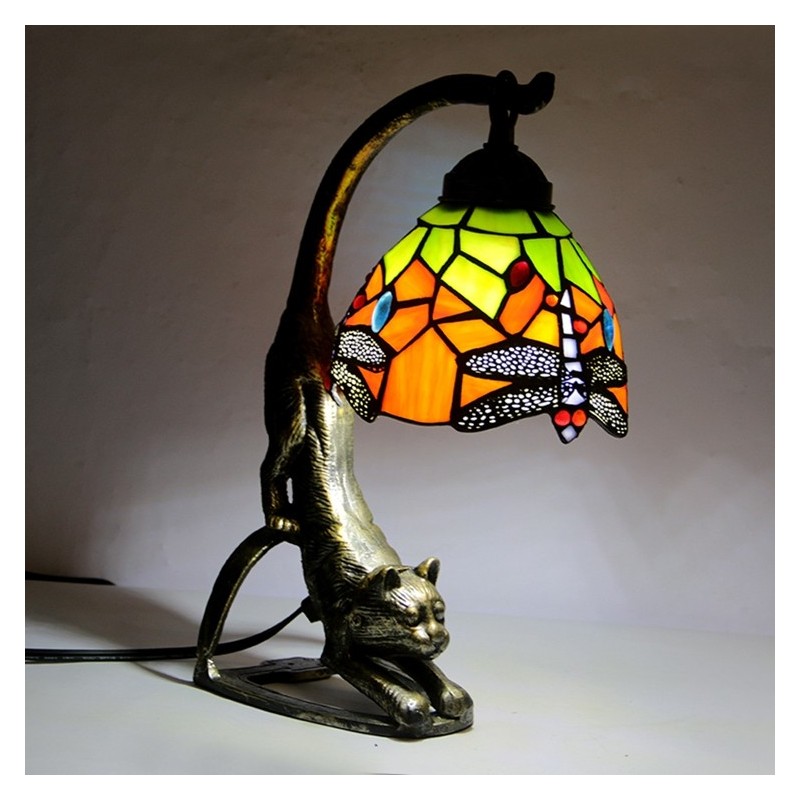
Dragonfly bedside lamp with cat base
A figurative table lamp used to discuss stability, children and pets, bedside switch reach and decorative scale.
This model demonstrates the method; it is not an automatic recommendation. Draw its complete dimensions, verify the current electrical specification and test the proposed light in the real room. Product details can change, so check the live page before buying.
Confirm on the product page: total dimensions, weight, voltage and connection, lampholder, maximum wattage, included parts and installation conditions.
Practical New Zealand home scenario
Use the room on an ordinary evening. Perform the article’s actual task, then note dark surfaces, reflections and any view of a bare bulb. Let Dragonfly bedside lamp with cat base provide colour and character, but add neutral task or ambient light wherever the working surface remains unclear.
Common mistakes
- Expecting one decorative lamp to solve every lighting task.
- Testing only while standing when glare occurs seated or lying down.
- Ignoring dark circulation routes after sunset.
Final checklist
- Every activity has appropriate light.
- Dark evening zones are mapped.
- No disruptive reflections remain.
- Controls are easy to reach.
- Decorative and functional light are balanced.
Record sheet: model, complete dimensions, total weight, voltage and connection, lampholder, chosen LED, position, mock-up photograph and check date. The current product information and maker’s instructions take priority over general guidance.
Explore relevant lamps
Tiffany table lamps · Tiffany floor lamps · Tiffany pendant lights